

Ensuring Reliable Performance in a Crowded Spectrum
My first exposure to wireless networking was when it became possible for me to send files to my printer over the 2.4 GHz band. That was almost 30 years ago. Data rates were not really fast, but fast enough to print documents or send e-mails. Since then, the number of devices using the unlicensed wireless spectrum and the available frequency band has grown significantly. Other than just being an interesting technology trend, many device manufacturers have found that using a wireless interface is more efficient and convenient than using traditional wired interfaces.
This is especially true for medical devices, especially in crowded emergency and operating rooms. (As a side note, I just had a doctor’s visit this morning and noticed the number of devices that still had wired interfaces to their sensors.) Multiple equipment with multiple wired interfaces can get in the way of lifesaving measures and can even present trip hazards.
Wireless Medical Devices in Healthcare Settings: Some Background
It should not be a surprise, then, that medical devices have a good reason to shift from wired to wireless interfaces. Figure 1 shows an AI-generated view of the growth of medical devices with wireless interfaces from 2020 to 2024.1
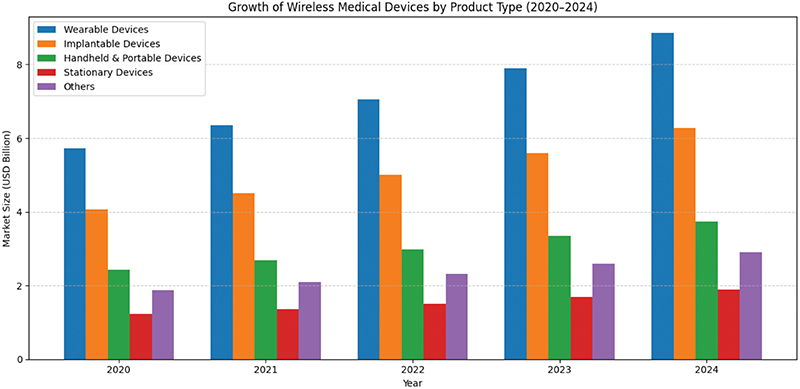
Here are some key insights from that study:
- Wearable devices lead the market, growing from $5.73B in 2020 to $8.85B in 2024, driven by fitness trackers, smartwatches, and wireless ECG monitors;
- Implantable devices (e.g., pacemakers, neurostimulators) show steady growth, reaching $6.27B in 2024;
- Handheld and portable devices (e.g., wireless glucose meters, ultrasound systems) are gaining traction due to mobility and ease of use.
- Stationary devices (e.g., wireless imaging systems) remain the smallest segment due to limited portability; and
- The “Others” category includes emerging technologies and niche applications, growing to $2.91B by 2024.
Today, with the increase of devices using wireless interfaces, there is an increased risk of interference. While the unlicensed frequency spectrum is “free,” that does not mean that the use of that spectrum will always be available. Along with that, the use of the frequency spectrum is very busy. Figure 2 shows the allocated frequency spectrum for the 2-3 GHz Band.
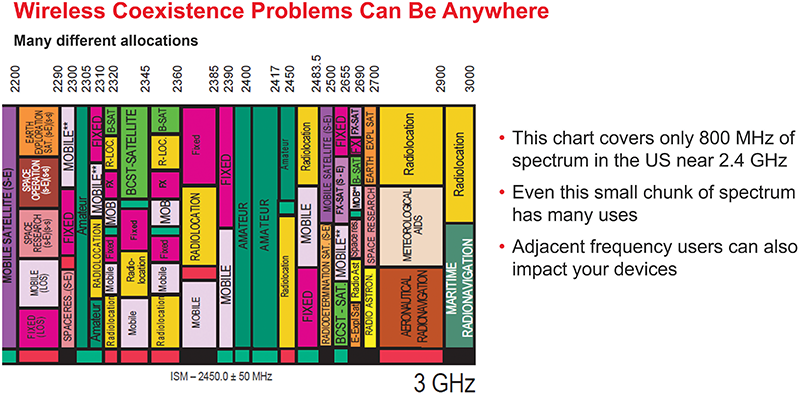
Medical devices will have to contend with transmitters that are either sharing the same channel, or even those that are not on the current operating channel but close enough in frequency to cause co-channel interference. On top of that, just about every patient and hospital employee will carry at least one wireless device with them, causing an even higher potential for interference.
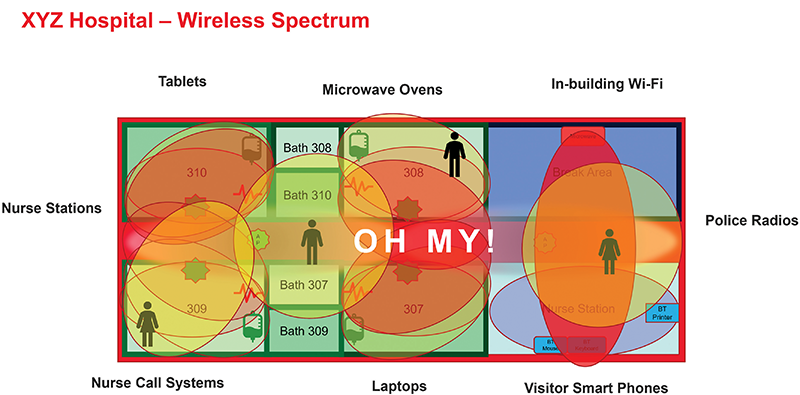
In addition, visitors enter the hospital with smartphones configured to be wireless hotspots or connected to Bluetooth headsets, fitness bands, and smart watches. People change locations, make phone calls, and access Wi-Fi and LTE data networks and other wireless services during their visit, adding to the RF energy. At times, the “computers-on-wheels” and portable X-ray machines traveling the hallways periodically upload huge image files.
Yes, coexistence is a problem, not only in hospitals but anywhere large numbers of wireless devices are deployed. But wireless communication in a healthcare environment has become especially difficult. There are so many devices using RF that some are unable to establish or maintain a communications link at the level required for satisfactory operation. Devices that formerly worked in the engineer lab are failing to operate as required in the healthcare setting. The problem is further exacerbated by systems designed to support home healthcare technologies and that operate in home environments where the Internet of Things (IoT) includes radios to door locks, video doorbells, cameras, thermostats, and home appliances.
Ultimately, this leads to the risk of interference causing device malfunctions, data loss from patient monitoring devices, and potential impacts on patient safety. The purpose of this article is to explain the principles, challenges, and methodologies of coexistence testing from the perspective of a medical device manufacturer. Similar issues would exist for a hospital/clinic setting, but with a slightly different perspective (perhaps a future article?).
The Regulatory Context for Coexistence Testing
Definition of Coexistence Testing
You may be thinking this sounds like EMI or EMC, and you are only partly correct. Assessments for EMI and EMC issues primarily evaluate radio frequencies other than the wireless frequency used by medical devices. EMI and EMC test the purity of transmissions and sensitivity to high external fields other than RF channels in use by the equipment under test (EUT). Coexistence testing uses the same and close-by radio frequencies, and does the test using the desired EUT functionality, measuring effects of interference on the behavior of the EUT.
Relevant Standards and Guidance
In the U.S., the Federal Communications Commission (FCC) is responsible for defining the rules and specifications for devices that use the frequency spectrum. The Food and Drug Administration (FDA) is responsible for establishing the requirements for medical devices and has recently had to address medical devices that integrate wireless interfaces. While the FDA does not define the rules and specifications for that wireless interface, it did have to start addressing issues caused by interference to those wireless interfaces.
Here are some of the relevant regulations, guidance documents, and standards applicable to coexistence testing of medical devices.
Radio Frequency Wireless Technology in Medical Devices – Guidance for Industry and Food and Drug Administration Staff 3
This FDA-issued guidance, initially released in 2007 and updated in 2013, recommends coexistence testing for wireless devices intended for use in health care. From that document, the following requirements are indicated before filing for FDA approval.
From section 4b. of that document:
-
- Wireless Quality of Service – The submission should include information to describe the wireless QoS needed for the intended use and use environment of the medical device. This includes addressing any risks and potential performance issues that might be associated with data rates, latency, and communications reliability as described in Section 3-b.
- Wireless coexistence – Any risks and potential performance issues that might be associated with wireless coexistence in a shared wireless environment should be addressed via testing and analysis with other wireless products or devices that can be expected to be located in the wireless medical device’s intended use environment. See Section 3-c.
Please note that the FDA considers this a guidance document, not a standards document, and also states:
This guidance represents the Food and Drug Administration’s (FDA’s) current thinking on this topic. It does not create or confer any rights for or on any person and does not operate to bind FDA or the public. You can use an alternative approach if the approach satisfies the requirements of the applicable statutes and regulations. If you want to discuss an alternative approach, contact the FDA staff responsible for implementing this guidance. If you cannot identify the appropriate FDA staff, call the appropriate number listed on the title page of this guidance.
ANSI C63.27-2021 – American National Standard for Evaluation of Wireless Coexistence4
Appendix A of the FDA Guidance Document lists reference documents to be reviewed for assessing the RF interfaces for medical devices. While that Appendix lists mostly EMC-related documents, the link in that section for all references does include a listing for ANSI C63.27, published in 2022 (after the publication of the FDA Guidance Document). This standard provides methods for evaluating the ability of a device to coexist in its intended RF wireless communications environment. While this is a recognized standard, it is by no means all that is required to meet the coexistence requirements of the FDA. View this standard as more of a minimum requirement (for reasons discussed later in this article).
AAMI TIR 69: Association for the Advancement of Medical Instrumentation – Risk Management of Radio-frequency Wireless Coexistence for Medical Devices and Systems (2017)5
This Technical Information Report (TIR) was developed by The Association for the Advancement of Medical Instrumentation (AAMI). It provides a process for defining risk management for medical devices that incorporate a wireless interface. It also references ANSI C63.27 for the recommended testing procedures, and the International Standards Organization (ISO) 14971 standard for risk management.
Regulatory Expectations
From the FDA guidance document, the following types of planning and execution are critical to a successful application for coexistence management:
- A summary of the coexistence testing, set-up, findings, and analysis;
- The wireless products (interferers) that were used in the coexistence testing, and their wireless RF frequencies, maximum output powers, and separation distances from the device;
- The specific pass/fail criteria for this testing;
- How the device and wireless functions were monitored during the testing and determined to meet the pass/fail criteria; and
- If it is reasonable to expect multiple units of the subject wireless medical device to be used in the same vicinity, the information should also address how the association and security between devices is established and maintained to prevent crosstalk among the devices.
The most challenging part of coexistence testing then is to determine the risk management plan to find the best fit for the specific EUT in its typical operating environments.
Wireless Technologies in Medical Devices
A key step in assessing the risk is to look at the wireless technologies that are implemented in the medical device. While the availability of different technologies and associated costs is very attractive, each has its own unique performance characteristics that will have a different response to coexistence with other wireless devices. Listed below are typical interface technologies for medical devices, and a description of their unique capabilities and performance.
Bluetooth®
Bluetooth comes in several different flavors, known as Bluetooth Classic and Bluetooth Low Energy (LE). Bluetooth Classic is the original implementation of Bluetooth Technology. It is a frequency hopping spread spectrum (FHSS) technology that uses a random hopping sequence of 79 possible channels with a 1 MHz bandwidth from 2402 to 2480 MHz. Because it uses a frequency hopping technique, it tends to handle interference from other sources better than other wireless technologies. Versions 1-3 of Bluetooth Classic have a maximum range of up to 10 meters.6
Bluetooth Low Energy (BTLE) is an extension to the original Bluetooth and was designed specifically to allow for lower energy use and longer battery life. Like Bluetooth Classic, it uses multiple channels, but in a different scheme. Three channels are dedicated as advertising channels and are not used for data transmission. It also utilizes a 1 MHz bandwidth in the same frequency range, with channels spaced every two MHz. Because of the wider channel spacing, there are less (40) total channels available. With half of the channels available for transmission, it can make BTLE more susceptible to interference compared to Bluetooth Classic.
Versions 4 and 5 of Bluetooth have a maximum range of up to 60 meters, and possibly 240 meters for BTLE Long Range.7 Because of the ease of implementation of either type of Bluetooth, this technology can be found in medical devices, especially those that are partnered with an application that runs on a smartphone or PC.
Zigbee8
Zigbee is an IEEE 802.15.4-based specification for a suite of high-level communication protocols used to create personal area networks with small, low-power digital radios, such as for home automation, medical device data collection, and other low-power, low-bandwidth needs for small-scale projects that need wireless connection. It uses a 2 MHz bandwidth, spaced every 5 MHz, in the 2.4 GHz band with a maximum of 16 channels. Zigbee has a maximum operating range (non-mesh) of 10-20 meters. Because this protocol uses the 2.4 GHz bands, it has all the interference considerations of other standards addressing this frequency band.
Wi-Fi
Wi-Fi is probably the largest wireless technology used for unlicensed spectrum. At least ten (10) different Wi-Fi standards have been released over the last 25 years that may be applicable to medical devices.9 This technology relies on an access point and paired station (or client) devices to transmit data back and forth. Wi‑Fi also lends itself to providing an Internet connection for the Station device, allowing control and requesting information from anywhere in the world.
Here is a brief description of the different Wi-Fi standards, with an emphasis on their use in the U.S.:
- 802.11b: Although it is the second Wi-Fi standard developed by the IEEE, it was the first implemented in September 1999. It uses the 2.4 GHz band, specifically 2401-2473 MHz. The channel bandwidths are 22 MHz, and it allows for 11 channels in the U.S. However, that does not mean that all 11 channels can be used in the same area, as 802.11b has overlapping channels. This standard has a maximum range of up to 35 meters.
- 802.11a: Released in September 1999, this standard makes use of the 5 GHz band only. It was the first expansion into the newly available 5 GHz band, allowing for higher data rates, but still limited to a 20 MHz bandwidth maximum. This was not an overlapping technology, thus allowing for up to 31 available channels and a maximum operating range of 35 meters.
- 802.11g: Released in June 2003, this standard uses only the 2.4 GHz band and a maximum bandwidth of 20 MHz. The smaller bandwidth allows for up to 4 channels in the band without overlapping. It has a maximum operating range of 38 meters.
- 802.11n: Released in October 2009, this was the first Wi-Fi standard to be branded by the Wi-Fi Alliance, known as Wi-Fi 4. It allows for both 20 and 40 MHz bandwidths and uses both the 2.4 and 5 GHz bands. Because of this, it also allows for a larger number of available channels, up to 43 for 20 MHz bandwidths, and 23 40 MHz bandwidths. It has a maximum operating range of up to 70 meters.
- 802.11ac: Released in December 2013, this standard is also known as Wi-Fi 5. It uses the 5 GHz band only, but allows for 20, 40, 80, and 160 MHz bandwidths, allowing for even higher data rates. It allows for 31-20 MHz, 14‑40 MHz, 7-80 MHz, and 3-160 MHz channels. It has a maximum operating range of up to 30 meters.
- 802.11ax: Released in May 2021, this standard is also known as Wi-Fi 6 (using 2.4 and 5 GHz bands only) and Wi-Fi 6E (E=Extended), which uses all three bands. This standard truly increased the capacity and capability of Wi-Fi, allowing for up to 103-20 MHz, 52-40 MHz, 21-80 MHz, and 10‑160 MHz channels. It has a maximum operating range of up to 30 meters.
- 802.11be: Released in September of 2024, this standard is also known as Wi-Fi 7 and uses all three bands. It allows for even wider bandwidths, adding 240 and 320 MHz channels. It also introduces the mandatory use of pre-amble puncturing, a technique that allows the device to notch out part of the channel in the presence of interference. This makes it one of the first standards to allow for managing interference in the operating channel. (Actually, this capability was available with Wi-Fi 6E but was optional). This standard has a maximum operation range of up to 30 meters.
- 60 GHz Wi-Fi: There are three different Wi-Fi standards using the 60 GHz band (802.11ad, aj, and ay) that are defined as multi-gigabit standards. They offer data rates between 1.08 GHz and 8.64 GHz with a maximum operating range up to 10 meters for 802.11ay. Because of the data rates, this standard may be used for applications that require very high data rates, such as high-resolution digital video. This band, while limited in operating range, would probably be the most immune to interference, as there are currently not many devices transmitting in this band.
A Word about Frequency Bands
As described in this section, Wi-Fi can use potentially up to three different frequency bands. Each has its benefits and limitations, as detailed here:
- 2.4 GHz: 2.4 GHz allows for longer transmitting distances but is limited in the number of channels and has to deal with multiple other technologies using this band. Microwave ovens operate in this band and can represent a significant interference source as well.
- 5 GHz: The 5 GHz bands allow for more channels and wider bandwidths (up to 240 MHz) and are popular for devices that use wider bandwidths and higher data rates. However, the 5 GHz band has some incumbent users that have priority access to the bandwidth. These include various forms or radars using the 5250-5350 MHz, 5470-5730 MHz bands. For that reason, APs and some station devices that use these frequencies must employ a radar detection function that monitors for defined radar signals and, if such signals are detected, must stop transmitting in that channel and not attempt to re-use that channel for up to 30 minutes (this is known as dynamic frequency selectivity, or DFS). It is possible to design the interface to avoid those bands, but that reduces the number of available channels to eight 20 MHz channels.
- 6 GHz: The 6 GHz band was opened for unlicensed devices in the U.S. in April 2020. The U.S. was the first country to allow use of the entire 6 GHz band, covering from 5925-7125 MHz. This allows for many channel possibilities, but, like the 5 GHz band, comes with some restrictions. There are multiple licensed (incumbent) users in the 6 GHz spectrum. As part of the agreement to use this band, any unlicensed device that uses this band must employ a contention-based protocol (CBP) in the U.S. Similar to the DFS requirements, devices using this band must also employ a receiver detection function that monitors for incumbent transmitters, and if detected above a threshold value, cease transmissions in this channel. Unlike the 5 GHz band, the device does not need to move from this channel, but can wait for the incumbent to stop transmitting, and then reuse the channel.
Cellular
In the past few years, device manufacturers have started integrating cellular wireless technologies into their devices. These technologies can use frequencies anywhere from the 700-900 MHz range, the lower and upper parts of the 2 GHz band, and most of the 5-6 GHz bands. These present potential co-channel interference issues with devices using the 2.4 GHz bands, and even the 5 and 6 GHz bands. Because these frequencies are licensed to use the assigned spectrum, they have priority over unlicensed devices operating in the same spectrum.
Coexistence Testing Methodologies
As mentioned previously, the first step is to develop the risk plan for your product and, from that, develop a comprehensive test plan rooted in the risk-based approach and using the standards listed previously. This includes:
Defining the Intended Use Environment
Is the device something that would only be used in an operating room? Or is it a wearable device that could be used anywhere? Will it be located in a static environment (fixed location) or mobile (such as in an ambulance)? This is the starting point to determine just how big or complicated a testing scenario you will need to develop.
Identify Wireless Technologies and Co-Located Systems
Secondly, build a list of wireless technologies used in your device, and the potential co-located systems operating in the same band or adjacent bands. Consider all potential medical (other medical devices with wireless interfaces) or non-medical (e.g., hospital APs, cellular phones, patient and visitor Bluetooth devices and locations), etc.
Conduct Spectrum Analysis
Ideally, as a device manufacturer, it would provide great insight if there were an actual spectrum analysis or signal monitoring of the intended use environment (this is the part I mentioned earlier as applying more to the hospital or clinic environment). Having an actual measured expected spectrum makes it easier to develop a targeted interference test plan.
Risk Assessment Matrix
With the previous information, evaluate the likelihood and severity of the interference-related failures that could happen. This is where the functional wireless performance (FWP), whether or not the device can perform its intended function and performance) comes into play. Be sure to include the following potential risk areas:
- Criticality of device function: Does this device provide life-sustaining functionality, or just monitoring?
- Impact of communication failure: Can the device still meet its functional performance with a loss of data or delayed alerts?
- Recovery mechanisms: Is there a designed recovery mechanism? Can the device recover by re‑transmitting the lost or corrupted data? Is there a fallback, such as an audible or visible alert on the device?
Define Performance Metrics
Once you have decided which risks need to be tested, you then need to consider how to measure the various performance metrics to determine if your device meets the FWP requirements. This includes establishing quantitative thresholds for acceptable performance under interference, such as:
- Packet error rate (PER)
- Latency
- Throughput
- Connection stability
- Sensitivity testing
- Time to recover
Test Set-up and Execution
The ANSI C63.27 standard defines three tiers to coexistence testing. Each tier is defined for different intended performance requirements for the medical device, as follows;
- Tier 1 represents the most thorough type of evaluation. Its purpose is to test those devices that have the highest consequences of unacceptable performance, or where the highest levels of uncertainty are required. This includes a wider range of unintended interference signals and the potential for interference from adjacent channel interference. This tier is for those products whose functional performance is the most critical.
- Tier 2 represents the mid-level type of evaluation. This Tier reduces the number of interference signals from Tier 1, and some testing is done for potential interference from adjacent channel interference. This Tier is for products that do not have such a critical performance requirement are not considered life-sustaining devices.
- Tier 3 represents the lowest level of interference testing. The intention is to provide the greatest insight into the EUT coexistence capabilities with the most limited amount of testing.
Annex A of the standard provides guidance for the types of interference scenarios that should be used based on the wireless interference in the EUT. For example, if the EUT employs just a Bluetooth interface, the recommended test signals include a combination of just a IEEE 802.11n Wi-Fi signal for Tier 3 to multiple IEEE 802.11n Wi-Fi signals and several adjacent band LTE signals for Tier 1.
Figure 4 shows an example of testing a Bluetooth LE device for all three Tier 1 scenarios.
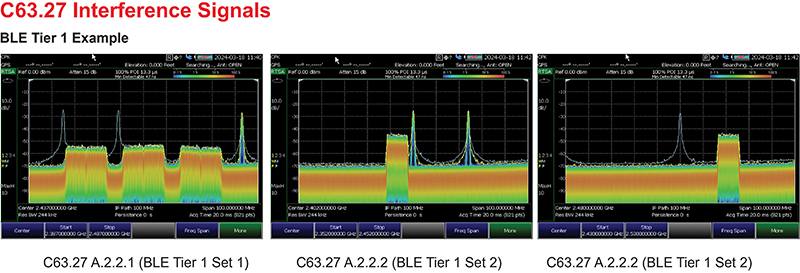
However, please keep in mind that this does not represent all that is required for coexistence testing but should be viewed as a minimum set of test scenarios. For example, if you know that your device would be considered a mobile device, you may want to consider adding scenarios where the interference signals change level with time to simulate moving towards or away from another wireless device. You may also want to consider the sensitivity of your EUT and vary the levels of the interference signal until the device fails to meet its KPIs.
Test Environments
The ANSI C63.27 standard allows for four different testing environments, as follows:
- Conducted:This environment is a fully conducted testing environment. The antennas are removed from the EUT, and all interference signals are fed into the EUT or companion device through cables. This environment allows for the most controlled testing, as you will not have to consider in-building Wi-Fi or Bluetooth signals being included in your testing. It also allows for the ability to use external components, such as variable attenuators, splitters, etc. for maximum control of the interference to EUT signal ratios.
- Dual Chamber:This environment moves towards a more realistic testing environment, as the EUT antennas are included in the test, and both the EUT and companion are in a shield chamber, virtually eliminating any external interference signals. All interference signals are then fed through antennas in each chamber. This environment is a bit challenging in that setting a desired interference signal level into the EUT takes some calculation of external measurements. Your test solution should provide a way to easily determine the radiated interference signal level to the EUT.
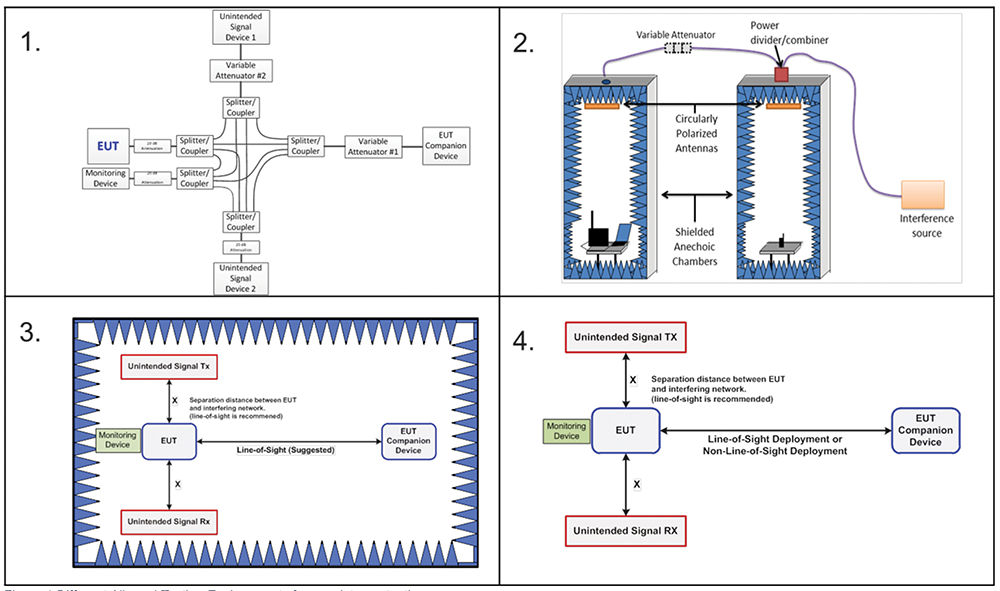
- Full Anechoic:This environment allows for the most control in testing the EUT and offers the most controlled testing environment. It shares similar issues to the dual chamber environment in determining the interference signal levels into the EUT. It also requires an anechoic chamber, which, if you do not have one, is a very expensive investment.
- Over-the-Air (OTA):This environment could be considered a poor man’s chamber environment. You basically test over the air in an open space, such as an unused conference room. There might be challenges in getting the distances far enough for far field, not to mention having to anticipate the in-building Wi-Fi and Bluetooth that will interfere with your interference testing.
Table 1 provides a summary of the pros and cons of each testing method.
| Method | Pros | Cons | Best Use Case |
| Conducted |
|
|
|
| Two-Chamber |
|
|
|
| Open Air |
|
|
|
| Anechoic Chamber |
|
|
|
Table 1: Testing method, pros and cons
Test Solution
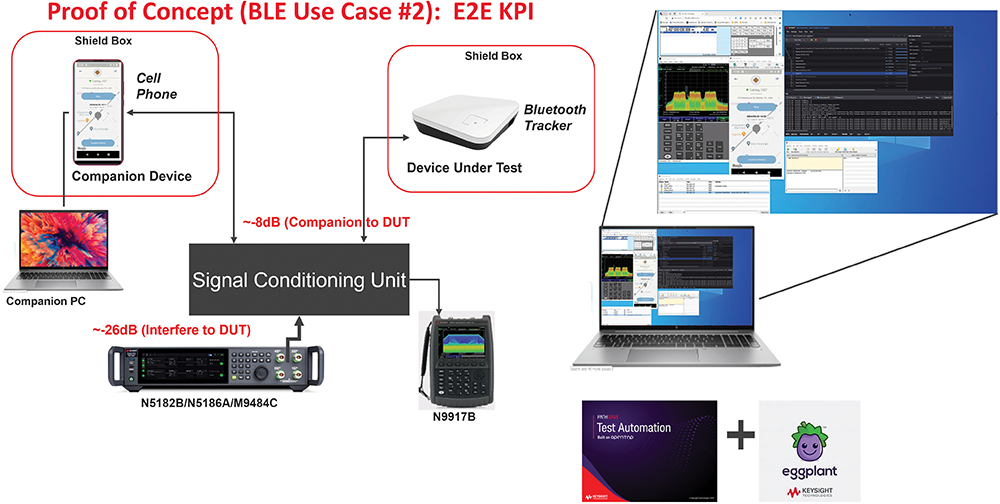
As you can see, a test solution can be as simple as a few commercially available Wi-Fi and Bluetooth devices. But, if you wish to extensively test beyond the requirements of ANSI C63.27 and consider roaming interferers, sensitivity testing, multiple variable interference sources, or perhaps a way to measure time to recover, it will require more than just commercial devices, and may still require a lot of manual analysis to fully evaluate your device.
Figure 6 shows an example of automated signal generators and signal conditioning to run complex interference testing. It also shows using software to read the display of the EUT application to determine if the KPI has met the desired functional performance. In this case, the software is monitoring the portion of the smartphone application to determine if the device is still connected to its companion device.
Summary
While the idea of managing coexistence for medical devices has been around for over 15 years, the practice of what makes the best or correct test continues to be a challenge today. Fortunately, the test equipment and software have evolved to allow for the design of very complex test scenarios to verify that both the FWP and KPIs for the EUT are met. Doing this supports the design validation before costly changes need to be made to the design and helps to avoid multiple review rounds for FDA approval.
Endnotes
- “Wireless Medical Devices Market Size | CAGR Of 12.1%”, Published: March 2025. Report ID: 141096
- https://www.ntia.doc.gov/files/ntia/publications/2003-allochrt.pdf
- https://www.fda.gov/regulatory-information/search-fda-guidance-documents/radio-frequency-wireless-technology-medical-devices-guidance-industry-and-fda-staff
- Available for purchase at: https://webstore.ansi.org
- Available for purchase at: https://aami.org
- https://en.wikipedia.org/wiki/Bluetooth#Specifications_and_features
- ibid.
- https://en.wikipedia.org/wiki/Zigbee
- https://en.wikipedia.org/wiki/IEEE_802.11